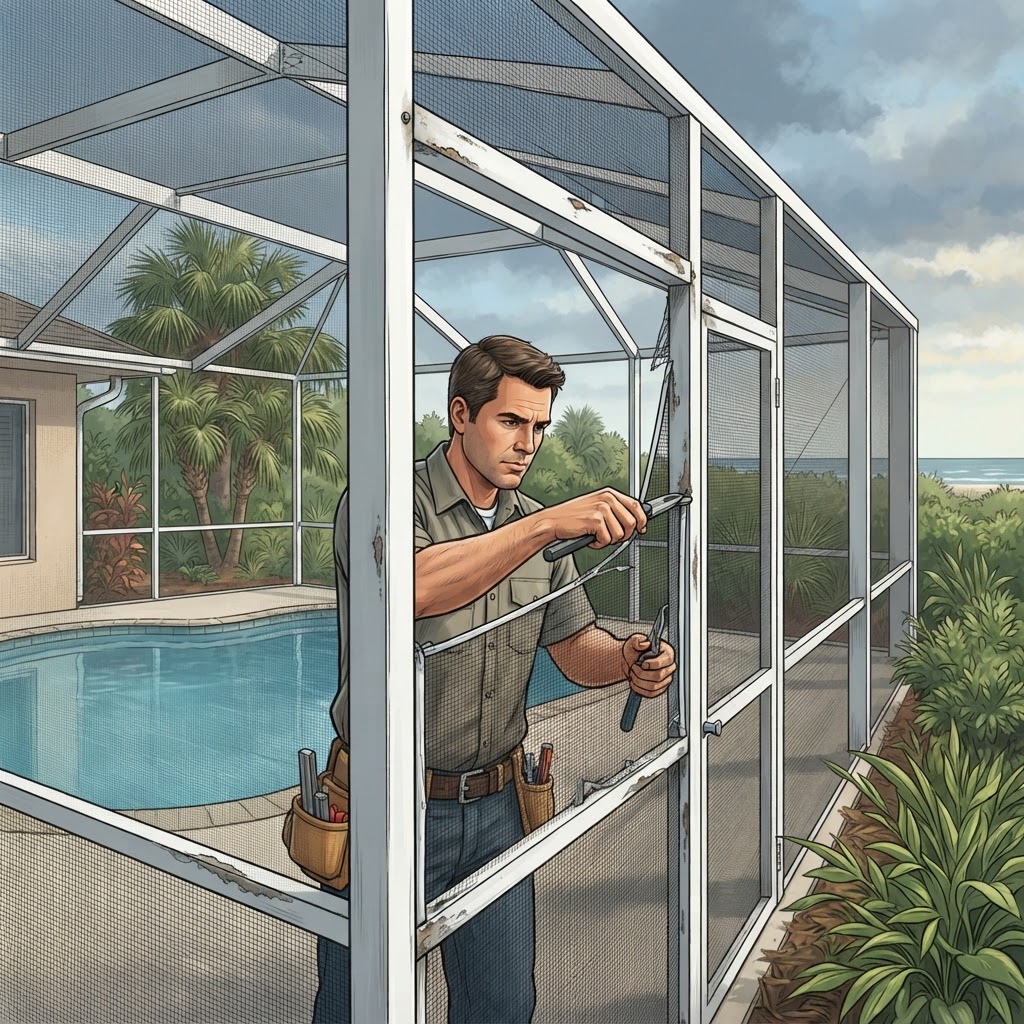
Hurricane Season and Pool Screens in Daytona: How to Protect Your Enclosure Before Storm Damage Hits
May 4, 2026 · Daytona Screen Repair
Daytona Beach hurricane season can wreck pool screens fast. Learn how high winds, salt air, and heavy rain damage enclosures—and what to do now.
Hurricane Season and Pool Screens in Daytona: How to Protect Your Enclosure Before Storm Damage Hits
From June 1 through November 30, Daytona Beach homeowners live through six long months of watching tropical forecasts, checking wind speeds, and hoping the next storm track stays offshore. In a coastal high-wind zone like Daytona Beach, Florida, it does not take a direct hurricane hit to damage pool screens and enclosures. One day of high winds, heavy rainfall, and flying debris can tear mesh, loosen fasteners, bend roof panels, and expose weak spots that have been quietly corroding in the salt air and humidity for months.
If you live near A1A, the Halifax River area, Dunlawton Avenue, or just west of International Speedway Blvd, you already know how quickly weather can change here. The same Atlantic breeze that feels great on a summer evening can become destructive when hurricane season ramps up. And because storm damage often starts small, many Daytona homeowners do not realize their enclosure is compromised until the next squall turns a minor rip into a major repair.
At Daytona Screen Repair, we help homeowners across Daytona Beach, Port Orange, Ormond Beach, and South Daytona protect what they already have before it becomes a bigger problem. As a 100% Disabled Veteran Owned, 4th-generation family business, we offer same-day service whenever possible and practical solutions built for Florida conditions.
Why hurricane season is so hard on pool screens and enclosures in Daytona Beach
Daytona Beach sits in one of Florida's most weather-exposed coastal corridors. That matters because pool screens and enclosures are designed to be durable, but they are still lightweight systems facing some very heavy forces.
High winds create pressure from multiple directions
During tropical storms and hurricanes, wind does not just push on one side of a pool cage. It swirls, lifts, and changes direction. That constant pressure can pop spline, rip screen mesh, and stress attachment points across the roof and walls. Homes closer to open areas, waterways, and the beach often feel this even more.
If you have ever driven by Daytona International Speedway on a windy afternoon and felt the crosswinds near International Speedway Blvd, you have a good sense of how exposed outdoor structures can be in this area. A pool enclosure takes that same kind of force for hours during a storm, not just a few seconds in traffic.
Heavy rainfall finds every weak spot
Heavy rainfall adds weight, reduces visibility during inspections, and exposes small failures around doors, kickplates, and lower panels. Water intrusion can also accelerate rust on fasteners and hardware, especially when an enclosure already has older framing or neglected maintenance.
Salt air and humidity speed up deterioration
Even between named storms, Daytona Beach weather wears on screen enclosures. Salt air can corrode screws, brackets, and frame components. High humidity supports oxidation, staining, and material fatigue. By the time hurricane season peaks in late summer and early fall, a cage that looked fine in spring may already be weakened.
That is why coastal homeowners in Florida cannot think of storm damage as one big event. It is often the result of months, or years, of smaller environmental stress adding up.
Want to know if your enclosure is storm-ready? Call us for a free estimate before the next weather alert.
The most common storm damage we see on Daytona pool screens and enclosures
Not all hurricane season damage looks dramatic at first. In many cases, the biggest repairs start with a small tear, a loose panel, or one corroded connection point.
Torn wall panels and roof panels
The most common issue is ripped screen mesh. Wall panels usually fail first when wind-driven debris hits the side of the enclosure. Roof panels often tear when uplift pressure builds from above or when a branch lands across the top structure.
Once one section tears, the surrounding panels take more strain. That is why delaying repairs can turn one damaged panel into several.
Loose spline and panel blowouts
Spline can dry out, shrink, or lose holding power over time. When that happens, high winds can pull the mesh free even if the screen itself is still in fair condition. We often see this after a tropical storm passes through Daytona Beach, Port Orange, or Ormond Beach and homeowners notice panels flapping or partially detached.
Bent framing and stressed attachment points
Pool enclosures are only as strong as the frame holding them together. Storm damage can show up as twisted members, loose fasteners, wobbling corners, or visible movement at the roof line. Sometimes the screen tear is only the symptom; the bigger issue is structural stress underneath.
Corroded hardware from salt air exposure
Near the coast, salt air is relentless. Screws, bolts, door closers, latches, and other metal components can rust faster than inland homeowners expect. Once corrosion starts, the enclosure becomes more vulnerable during hurricane season because each connection point has less holding strength.
Damage to adjacent screened areas
Storms do not limit themselves to pool cages. We also see damage to lanais, porches, and windows after summer squalls and tropical systems. If your property has multiple screened areas, it may make sense to address them together with Lanai Screen Repair, Porch Screen Repair, or Window Screen Repair while the crew is already on-site.
If you have even one loose or torn panel, now is the time to schedule service before the next round of high winds.
How to reduce storm damage before the next tropical system
The best time to deal with hurricane season problems is before your neighborhood is under a tropical storm watch. Preventive maintenance is almost always easier and more affordable than emergency work after a storm.
Start with a pre-season inspection
Look for:
- ✓small tears or pinholes in mesh
- ✓loose spline or sagging screen panels
- ✓rusted fasteners and brackets
- ✓sticking or misaligned doors
- ✓frame movement at corners or roof joints
- ✓discoloration or corrosion from humidity and salt air
A quick inspection in early summer can reveal what your enclosure needs before the weather gets serious.
Trim back trees and clear loose yard items
Flying debris is one of the fastest ways to create storm damage. Branches, patio furniture, toys, and even lightweight pool equipment can turn into projectiles during high winds. Keeping the area around the enclosure clear reduces impact risk.
Repair weak sections before they fail
A single compromised panel can create a chain reaction. That is why proactive Pool Screen Repair matters. Replacing damaged sections before a storm helps preserve the rest of the enclosure and reduces the odds of larger blowouts.
Do not ignore non-pool screens
If your front porch, lanai, or windows have failing screen sections, those openings can also suffer during hurricane season. Homeowners often call us for one issue and then realize the whole property needs attention. You can explore all options on our Services page or get more seasonal tips on our Blog.
After the storm, inspect quickly
Once conditions are safe, walk the enclosure and check for fresh tears, bent members, missing spline, or corrosion that got worse after heavy rainfall. Even if the damage looks minor, fast repair helps prevent the next afternoon thunderstorm from making it worse.
Need same-day service after a storm passes? Call Daytona Screen Repair and we will help you assess the damage fast.
When to repair, rescreen, or upgrade your Daytona enclosure
A lot of homeowners ask the same question after hurricane season starts: should I patch the damaged area, replace panels, or do a full rescreen?
Repair is usually best when damage is isolated
If the enclosure is otherwise in good shape and only a few sections failed, targeted repair is often the smartest move. For many Daytona Beach homes, straightforward storm repairs start at:
- ✓Wall panels: $75
- ✓Roof panels: $175
Those are common starting prices for individual storm-damaged sections. Final pricing depends on access, mesh type, height, and overall enclosure condition.
Full rescreening makes sense when the mesh is aging everywhere
If multiple panels are brittle, faded, loose, or repeatedly tearing, a full pool enclosure rescreening may save money over time. Full rescreens are priced on-site because each cage is different in size, roof design, frame condition, and screen material needs.
For homes near Daytona Beach Shores, along A1A, or in other high-exposure locations, full rescreening can be a smart way to reset the entire enclosure before another active Florida storm season.
Upgrades help you stay ahead of future weather
When we inspect a cage, we also look at door hardware, spline retention, and signs of corrosion. Sometimes the best long-term choice is not just replacing mesh, but improving weak points so the enclosure holds up better through humidity, salt air, and the next round of heavy rainfall.
This is also a good time to address adjacent screened spaces with Lanai Screen Repair or Porch Screen Repair, especially if the whole property has aged under the same coastal conditions.
Not sure whether you need a panel repair or full rescreen? We will give you an honest recommendation and a free estimate.
People Also Ask About Hurricane Season, Pool Screens, and Enclosures
Can pool screens withstand hurricane-force winds in Daytona Beach?
Pool screens and enclosures are built for everyday Florida weather, but hurricane-force winds can still cause failures, especially if the mesh is old, the spline is loose, or hardware has been weakened by salt air and humidity. In Daytona Beach, even outer bands from a tropical system can create enough wind pressure to tear vulnerable panels. The best defense is regular inspection and early repair before hurricane season peaks.
What causes the most storm damage to pool enclosures?
The most common causes are high winds, flying debris, heavy rainfall, and corrosion that has already weakened the structure. In many cases, the storm that causes visible damage is not the first problem. Salt air and humidity may have been degrading fasteners and frame connections for months, making the enclosure easier to damage when the next storm arrives.
How often should a Daytona Beach pool screen enclosure be inspected?
At minimum, once before hurricane season and once after any major storm event. Homes in more exposed areas of Daytona Beach, Ormond Beach, or New Smyrna Beach may benefit from more frequent checks because coastal wind, salt, and sun can shorten the life of screen materials and metal components.
Should I repair storm damage right away, or can it wait?
Repair it as soon as possible. A small tear can spread quickly, especially during summer thunderstorms and windy afternoon weather. Delaying service also allows more stress on surrounding panels and may let moisture worsen rust or corrosion in the enclosure hardware.
Have a question about your own enclosure? Call us and get local answers from a Daytona team that works on these systems every day.
What Daytona homeowners are saying
Storm season is stressful enough. Homeowners want a company that shows up, explains the problem clearly, and fixes it correctly.
We had two roof panels tear after a windy storm near Dunlawton Avenue in Port Orange. Daytona Screen Repair came out quickly, gave us a fair quote, and had it fixed the same day. — Maria T., Port Orange
Our pool cage in Ormond Beach had rusted fasteners and a wall panel that kept getting worse after every storm. They explained exactly what needed repair and what could wait. No pressure, just honest help. — James R., Ormond Beach
After summer storms near the Halifax River area, our enclosure in Daytona Beach Shores had multiple tears. The crew was professional, fast, and respectful of our property. — Alicia M., Daytona Beach Shores
Daytona homeowners choose local for a reason. We understand how weather moves through Volusia County, from beachside gusts to inland thunderstorms. We know what salt air does to hardware, what heavy rainfall exposes, and how quickly hurricane season can change a minor issue into a major repair.
As a 100% Disabled Veteran Owned, 4th-generation family business, Daytona Screen Repair is proud to provide same-day service whenever scheduling and weather allow. If your pool screens or enclosures have storm damage, or you want to get ahead of the next storm, call (321) 926-1774 today or request a free online estimate. We proudly serve Daytona Beach, South Daytona, Port Orange, Ormond Beach, and nearby Volusia County communities.
Protect your enclosure before the next storm warning—call (321) 926-1774 today for your free estimate.
Watch: how to prepare pool screen enclosure for hurricane season Florida
Frequently Asked Questions
Learn More From Trusted Sources
Official NOAA hurricane forecasts, advisories, and storm tracking information.
Hurricane safety guidance, preparedness tips, and weather hazard information from NOAA.
Federal hurricane preparedness and recovery advice for homeowners from FEMA.